
Plastic vs. Bagasse vs. Cornstarch Party Tableware: A Wholesale Comparison for High-Volume Buyers
Plastic vs. Bagasse vs. Cornstarch Party Tableware: A Wholesale Comparison for High-Volume Buyers
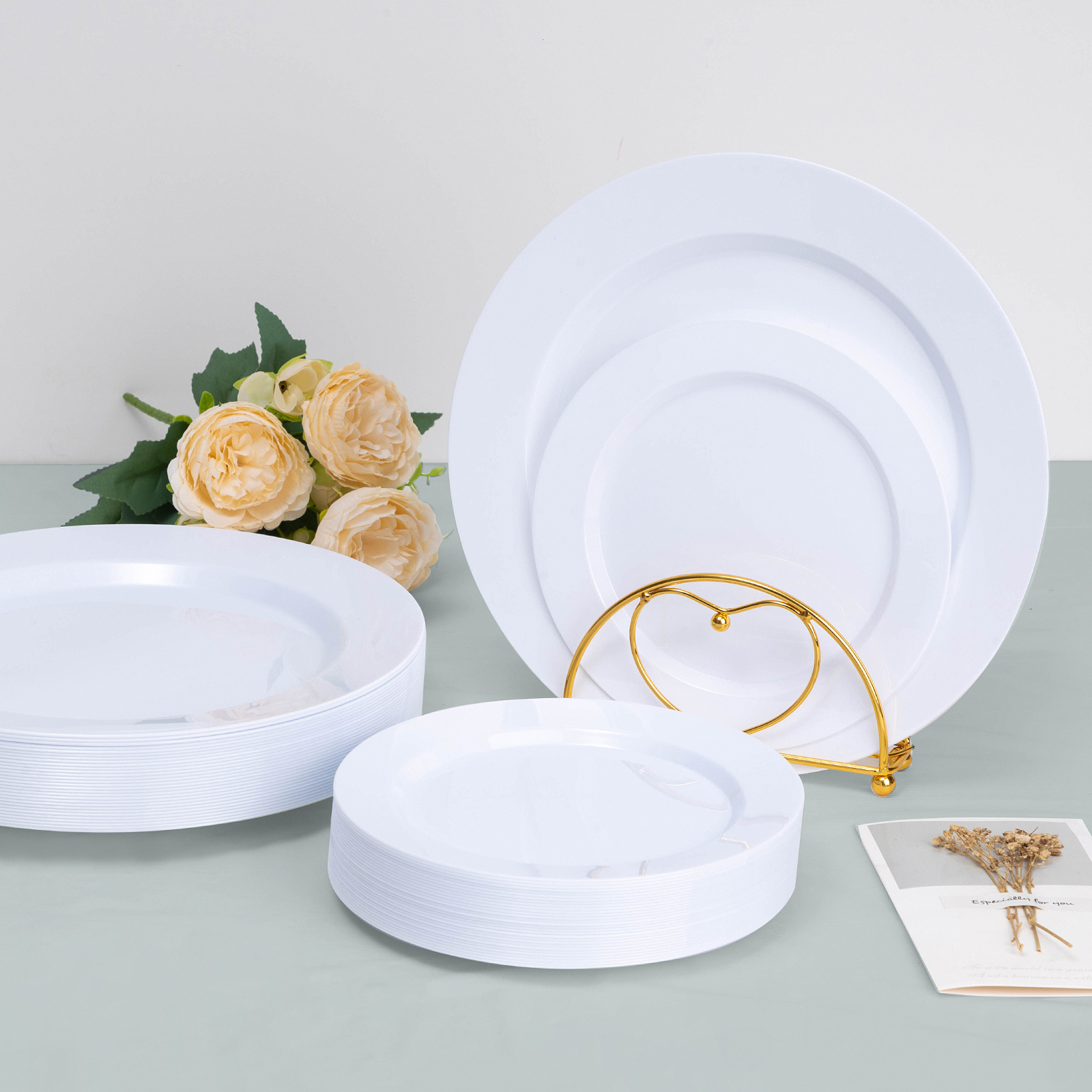
For wholesale buyers, the choice between plastic, bagasse, and cornstarch party tableware is decided by four variables rather than by marketing language: piece weight, reuse cycles, heat resistance, and application fit. Food-grade PS plastic sets such as YISOO's TA50B and TA50C carry a 30% heavier construction than standard disposable-grade party plates and support roughly 5–10 hand-washed reuses per piece. Bagasse tableware (model PC-CP) and cornstarch tableware (model BB-CS) are engineered as single-service formats, each with its own declared heat range and end-of-life requirement. This comparison converts those specifications into the two figures a volume buyer actually needs: cost per use and scenario fit for weddings and high-end banquets.
Problem Definition: Why Price-Per-Piece Comparison Breaks Down
Party tableware wholesale quotations are almost always issued as a price per piece, and buyers naturally compare materials on that single number. The comparison breaks down for four structural reasons.
- Weight is quoted, but never shown. A 30% heavier construction consumes more resin and adds freight cost per piece, yet it is the variable that determines whether a plate holds a plated banquet meal without flexing at the rim.
- Reuse is invisible in a per-piece price. A piece reused 5–10 times divides its purchase cost across multiple services. A single-service piece does not, and the quotation never shows the difference.
- The heat ceiling silently disqualifies a material. PS tableware is rated below 70°C and is not microwavable; bagasse is rated to 120°C for short-term exposure; cornstarch to 100°C. A menu containing hot soup or a warming tray decides the material before any commercial negotiation begins.
- End-of-life depends on infrastructure the buyer may not control. Bagasse decomposes completely in 60–90 days under industrial composting, which requires a managed collection stream rather than a general waste bin.
The cost of getting this wrong does not appear on the purchase order. It appears as warped plates under a hot main course, as retail returns caused by a lighter-gauge plate splitting at the rim, or as a sustainability claim a venue cannot substantiate. High-volume buyers therefore need a comparison built on service conditions, not on unit price alone.
Industry Background: Volume Demand, Regulation, and a Two-Track Market
The party supplies market remains large and growing. Fortune Business Insights values the global party supplies market at approximately USD 18.41 billion in 2025 and projects USD 41.52 billion by 2034, with tableware and disposables as the leading product segment at approximately 50.92% of the global market in 2026. Within that total, demand is splitting rather than converging.
The biodegradable side has developed its own scale. Grand View Research and Coherent Market Insights estimated the global biodegradable tableware market at USD 15.3 billion in 2024, with bagasse products holding a dominant material share of about 43%. Market Research Future projects bagasse tableware to grow at a CAGR of 10.12% between 2025 and 2035, driven by plastic-free wedding and event catering demand.
Regulation reinforces the split. The European Union's EN71-1:2026 revision introduces stricter visual and sensory inspection requirements for food-imitating party supplies and toys, which affects how molded fiber and bioplastic items are finished and inspected. In the United States, FDA certification is mandatory for all wholesale party cups and tableware exported to the U.S., ensuring food contact safety and material compliance. Established players compete across both tracks — Party City (US), Huhtamäki Oyj (Finland), Pactiv Evergreen (US), and Dart Container (US) among them — which means a buyer's material decision sits inside a market that supports plastic and bio-based positions simultaneously.
The operational implication is that plastic PS, bagasse, and cornstarch are not successive generations of one product. They are parallel product families serving overlapping but distinct service conditions.
Detailed Solution: The Three Material Families in YISOO's Wholesale Range
YISOO (Zhejiang Yisoo Household Technology Co., Ltd.) is a full-service party supplies provider founded in 2023 that integrates design, manufacturing, and global trade. It operates a 16,000 m² production and warehousing hub with more than 200 staff, a 20-person product design team, and an annual output of 1,000,000 units. Production is 100% export-oriented across EU, USA, and Middle East markets, supported by a U.S. warehouse that provides localized storage and faster fulfillment for North American partners. Its tableware portfolio covers all three material families compared below.
1. Plastic PS Tableware Sets (Models TA50B and TA50C)
YISOO's core plastic option is a food-grade, BPA-free PS (polystyrene) tableware set supplied under models TA50B and TA50C. A standard set contains a 10.25" dinner plate, a 7.5" salad or dessert plate, a 7.4" fork, a 7.8" knife, a 6.9" spoon, a 9 oz cup, and a napkin, produced by injection molding with metallic gold hot stamping and offered in white with gold rim, silver rim, or custom colors.
Components are also available individually for buyers building their own configurations: PA10 and PB10 plates in 10.25", 9", 7.5", and 6" diameters; KA07 and KB07 cutlery with 6.8" spoons, 7.4" forks, and 7.8" knives; CA09 cups in 9, 10, 12, and 14 oz tumbler formats configured for 25, 50, or 100 guest place settings; and CF12 and CB04 stemware in a 12 oz whisky glass and a 9 oz champagne glass.
Two specification points drive the buying decision. First, the set is built on a 30% heavier construction than standard disposable-grade party plate sets, which is what allows each piece to be hand-washed and reused approximately 5–10 times before retirement. Second, declared heat resistance is below 70°C and the product is strictly non-microwavable: it must not be used for boiling liquids, freshly deep-fried foods, or piping-hot soups, and must be kept away from traditional ovens and commercial food warmers.
2. Bagasse Tableware (Model PC-CP)
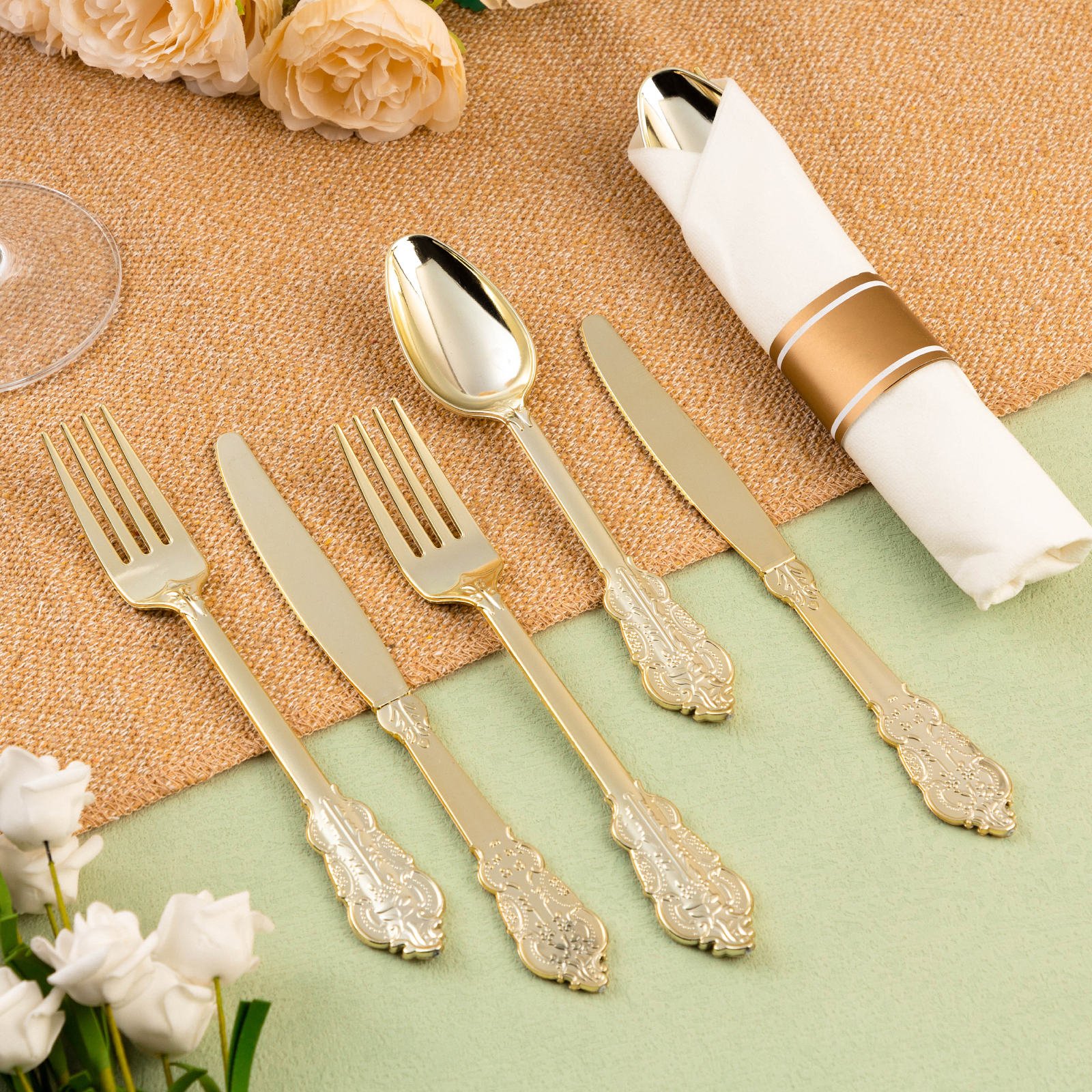
The bagasse range, supplied under model PC-CP, is molded from 100% sugarcane bagasse pulp, an agricultural by-product fiber. The material is unbleached and finished in a natural ivory or beige tone. The range covers 6, 7, 8, 9, and 10-inch plates, bowls from 240 ml to 1000 ml, cups from 2 to 12 oz, and 160 mm cutlery. Plates and bowls are formed by hot press molding; cutlery is pulp molded.
Declared heat resistance is −20°C to 120°C for short-term exposure, which places bagasse above the other two families for hot holding. The material decomposes completely in 60–90 days under industrial composting. That condition is the one buyers most often misread: compostability is a property of the disposal stream as much as of the product, so bagasse only delivers its end-of-life advantage where the venue or municipality operates industrial composting.
3. Cornstarch Tableware (Model BB-CS)
The cornstarch range, model BB-CS, is produced from a cornstarch-based resin described as an eco-friendly bioplastic or PLA composite containing up to 60–70% renewable corn starch. It is offered in classic milk white and matte translucent finishes and covers plates, bowls, cups, and cutlery sold by the piece. Production uses precision injection molding and thermoforming to achieve uniform wall thickness and a smoother surface than molded fiber. Declared heat resistance is −15°C to 100°C.
For buyers, cornstarch sits between the other two families. It carries a higher heat tolerance than PS and a cleaner, matte surface than bagasse, while retaining a renewable-content claim. It is not a fiber product and does not reproduce bagasse's unbleached, natural aesthetics, which matters when an event's décor direction depends on that look.

The Four Criteria That Decide a High-Volume Order
Weight and rigidity
Piece weight is the closest proxy a buyer has for rigidity before a physical sample arrives, and it is the first number to request on any quotation. In YISOO's range, the plastic tableware set carries a documented 30% heavier construction than standard disposable-grade party plate sets. The bagasse and cornstarch specifications in this comparison do not declare a gram weight per piece, so buyers should request a measured piece weight and a rim-load test for those SKUs rather than assuming parity. Weight also carries a freight consequence: heavier plastic raises per-container shipping cost, and that belongs inside the landed cost figure rather than in a separate column.
Reusability and real use cycles
Reusability separates the materials more sharply than any other criterion. The plastic set is designed to be washed by hand and reused roughly 5–10 times, which is the basis of its cost-per-use advantage. The bagasse and cornstarch specification sets do not state a reuse cycle, and both are engineered as single-service formats intended to enter a composting or disposal stream after one use. Buyers planning multi-day events, or supplying venues with on-site washing capability, should treat plastic as the reuse-capable option and the two bio-based families as single-service unless a supplier confirms a reuse cycle in writing.
Heat resistance and service temperature
Service temperature is a hard constraint rather than a preference. PS tableware is rated below 70°C, is non-microwavable, and must never carry boiling liquids, deep-fried items, or piping-hot soups. Bagasse is rated from −20°C to 120°C for short-term exposure. Cornstarch is rated from −15°C to 100°C. A menu built around hot plated mains held under a warming lamp therefore favours bagasse or cornstarch, while a cold-platter, dessert, or beverage-led programme fits PS without compromise. All three products are positioned for party and catering service; none is described as intended for oven or microwave use.
Application fit
Application fit is where the three families stop competing and start complementing each other. A formal evening wedding reception with a ceramic-look table setting fits the PS set with gold or silver rim. An outdoor garden reception serving hot food, where the venue has a composting partner, fits bagasse. A daytime corporate reception or a retail shelf programme with a minimal, matte aesthetic fits cornstarch. Most high-volume accounts end up stocking two of the three rather than replacing one with another.
Step-by-Step Breakdown: Building a Mixed-Material Wholesale Order
- Fix the service window and menu temperature profile. Record the highest and lowest serving temperature for every course. Any line above 70°C removes PS from consideration for that line.
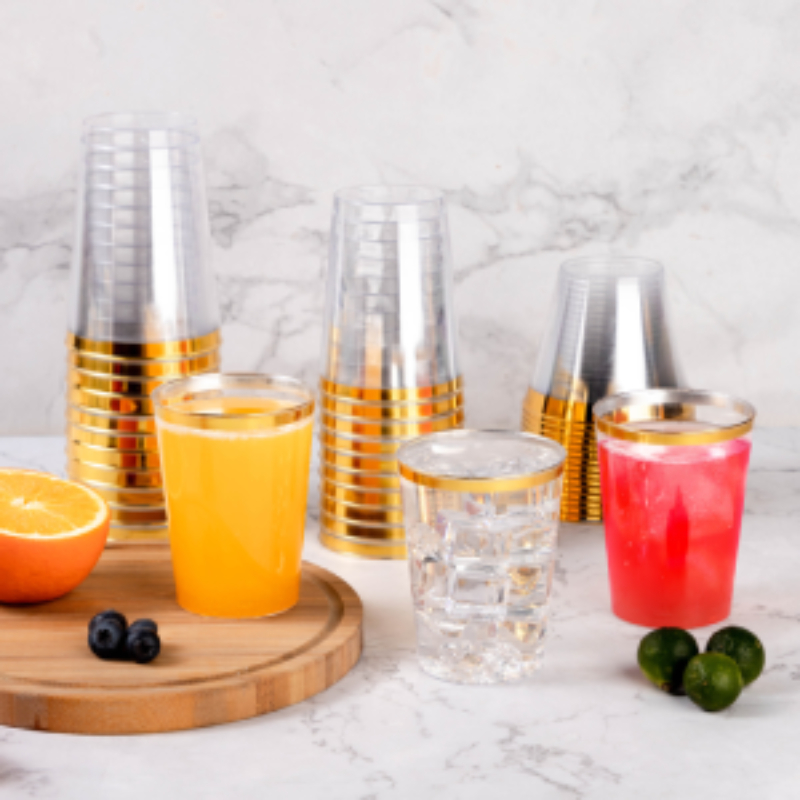
- Assign a material to each menu line, not to the whole order. A reception can legitimately run PS for the dessert and beverage courses and bagasse for the hot main.
- Request piece weight and rim-load data for every candidate SKU. Ask for gram weight per piece and a load figure, and compare the specs side by side rather than by feel.
- Model cost per use with the reuse count stated explicitly. Calculate (landed piece cost + handling and disposal cost) ÷ verified uses per piece. State the reuse assumption in the model so it can be challenged.
- Verify certification coverage per destination market before design work. Certification is a market-entry condition, not a finishing detail, and re-testing after artwork is approved is the most expensive way to discover a gap.
- Confirm kitting, printing, and packaging. YISOO supports silk screen printing, in-mold labeling, UV printing, custom party kits that bundle plates, cutlery, and drinkware, and retail-grade packaging design from display box to master carton.
- Schedule against the production funnel. YISOO's programme parameters are a MOQ of 1,000 pieces, a monthly capacity of 250,000 units, and a lead time of 15–30 days, with 100% testing and a pre-production sample stage.
Use Cases: Weddings, High-End Banquets, and Retail Programmes
Wedding receptions. YISOO's tableware is designed for weddings that aim at a fine-dining aesthetic without the cost and logistics of rental china. In this scenario the PS set functions as a visual substitute for ceramics, integrates into the reception table setting, and removes breakage management and post-event dishwashing from the venue's workflow.
High-end banquets and corporate hospitality. For large-scale corporate hospitality and high-traffic receptions, the priority shifts to operational efficiency. A rigid, shatterproof service format allows rapid venue turnover and streamlined catering operations, which is where the 30% heavier plastic construction earns its freight premium.
Outdoor and hot-service events. Where the venue or the caterer operates industrial composting and hot food must be served, bagasse's 120°C short-term rating and 60–90 day decomposition window address both requirements at once. Cornstarch suits programmes that need a 100°C service range with a matte, non-fiber finish.
One distributor's pattern. A U.S. party supply store owner handling 50,000–80,000 pieces per month began by market-testing through YISOO's U.S. warehouse. Once sales stabilised, the account moved to bulk stocking, and the relationship has run for 5–6 years, with 2025 annual sales up 18% compared with the previous year. That sequence — test locally, then commit to volume — is the standard entry path for buyers new to a material switch.
Comparison Table
| Criterion | Plastic PS set (TA50B / TA50C) | Bagasse (PC-CP) | Cornstarch (BB-CS) |
|---|---|---|---|
| Base material | Food-grade, BPA-free PS (polystyrene) | 100% sugarcane bagasse pulp, agricultural by-product fiber | Cornstarch-based resin (bioplastic / PLA composite), up to 60–70% renewable corn starch |
| Construction weight | 30% heavier than standard disposable-grade party plate sets | Not declared in the current specification set — request gram weight per piece | Not declared in the current specification set — request gram weight per piece |
| Heat resistance | Below 70°C; non-microwavable; no boiling liquids, deep-fried food, or piping-hot soups | −20°C to 120°C (short-term) | −15°C to 100°C |
| Reusability | Hand-wash reuse, approximately 5–10 cycles per piece | Single-service; no reuse cycle stated | Single-service; no reuse cycle stated |
| End-of-life profile | Disposable premium format; reuse extends service life before disposal | Complete decomposition in 60–90 days under industrial composting | Bio-based resin with renewable corn starch content; sold by the piece |
| Certification coverage in this specification set | EU Food Contact Material Test Report (8825)136-0074 and FDA compliance report (9024)179-0250, both issued by Bureau Veritas | Not included in this specification set — confirm per order | Not included in this specification set — confirm per order |
| Finish and colour | White with gold or silver rim, custom colours; metallic gold hot stamping | Natural ivory / beige, unbleached | Classic milk white or matte translucent |
| Format range | 10.25" dinner plate, 7.5" salad plate, 7.4" fork, 7.8" knife, 6.9" spoon, 9 oz cup, napkin; matching plates, cutlery, cups, and stemware sold separately | 6–10" plates, 240–1000 ml bowls, 2–12 oz cups, 160 mm cutlery | Plates, bowls, cups, and cutlery sold by the piece |
| Best-fit scenario | Formal wedding receptions, high-end banquets, retail shelf programmes needing a ceramic-look finish | Outdoor and hot-service events with access to industrial composting | Daytime corporate receptions and retail programmes favouring a matte, minimal finish |
FAQ
What certifications should a high-volume buyer verify before importing party tableware into the EU or the USA?
Two documents cover the plastic tableware range. For the EU market, the product is covered by an EU Food Contact Material Test Report, certification number (8825)136-0074, issued by Bureau Veritas against standards (EU) No. 10/2011 and (EU) 2020/1245, valid to 2027-05-30. For the USA market, it is covered by a compliance report, certification number (9024)179-0250, issued by Bureau Veritas against FDA 21 CFR 177.1640, valid from 2024-07-01 to 2027-07-01. Buyers should also track the EU's EN71-1:2026 revision, which tightens visual and sensory inspection for food-imitating party supplies, and note that FDA certification is mandatory for party cups and tableware exported to the United States. Certification documentation for bagasse and cornstarch items is not part of this specification set and should be confirmed per order.
How do plastic, bagasse, and cornstarch tableware differ in heat resistance and reuse?
Plastic PS tableware is rated below 70°C and is non-microwavable, but its 30% heavier construction supports hand-washed reuse of approximately 5–10 cycles per piece. Bagasse tableware is rated −20°C to 120°C for short-term exposure and is a single-service format with no stated reuse cycle. Cornstarch tableware is rated −15°C to 100°C and is likewise a single-service format. The practical rule is that heat above 70°C removes PS from that menu line, and any requirement to wash and re-serve removes bagasse and cornstarch.
How should a wholesale buyer calculate cost per use across the three materials?
Cost per use equals (landed piece cost + handling and disposal cost) divided by verified uses per piece. The divisor is the variable buyers most often set to one by default. For the plastic set, a stated reuse figure of 5–10 hand-washed cycles divides the piece cost across multiple services; for bagasse and cornstarch, the divisor is one because no reuse cycle is specified. A comparison that applies the same divisor to all three materials will systematically misprice the plastic option. Where budget pressure is the constraint, YISOO also offers material blending and cost engineering by adjusting the ratio of virgin resins to recycled content (PCR) against the target price point and market requirement.
Can we validate all three materials before committing to a volume order?
Yes. YISOO provides a pre-production sample as its standard after-sales milestone, and the MOQ is 1,000 pieces, which allows a low-commitment validation run before volume stocking. For North American buyers, the U.S. warehouse supports localized market testing first, then a transition to bulk stocking once sell-through is established — the pattern followed by a U.S. party supply store owner now handling 50,000–80,000 pieces per month.
What lead times, MOQ, and capacity limits apply to a mixed-material order?
YISOO's production parameters are a MOQ of 1,000 pieces, a lead time of 15–30 days, a monthly capacity of 250,000 units, and 100% testing on production. Export markets served are North America, the Middle East, and Europe. Buyers assembling a mixed plastic, bagasse, and cornstarch programme should confirm the split across the three material lines at the sampling stage so that tooling, artwork, and packaging approvals are completed before the production window opens. To request matched samples across the three material families or a quote against your volume forecast, contact market@yisoo.com or review the full range at yisoo.com.
Conclusion
Material selection in party tableware wholesale resolves into a short set of decisions. Choose PS plastic when the requirement is a formal, ceramic-look table setting, load-bearing rigidity, and a reuse multiplier of 5–10 that pushes cost per use below the single-service equivalent. Choose bagasse when the event needs a 120°C short-term heat ceiling and the venue has access to industrial composting for the 60–90 day decomposition path. Choose cornstarch when the requirement is a matte finish, a renewable-content claim, and a 100°C service range. The comparison only becomes misleading when the cost model ignores weight, reuse, and the heat ceiling — the three variables that never appear on a per-piece quotation.
Next step: YISOO manufactures and supplies all three material families from a single production base, with ODM customization, 100% testing, a 1,000-piece MOQ, and 15–30 day lead times.
Request matched samples across plastic, bagasse, and cornstarch formats, or a quote against your volume forecast, at yisoo.com — market@yisoo.com.
Have Questions or Need More Details?
Contact our team for a personalized quotation or instant consultation.
Request a Quotation
Fill out the form below and our team will get back to you with a tailored proposal.
WhatsApp Direct Chat
Prefer to chat in real-time? Message us on WhatsApp for instant assistance & quick answers.
- Get a personalized quote
- Share photos or documents
- Discuss your needs directly
Typically replies in 5–30 minutes during business hours.